PROCESS EQUIPMENT & PLANT ENGINEERING
Machinery & Equipment
For many years Florma has worked on the problems the industry brings us, seeing long and complicated processes through to a result that runs and pays for itself.
The equipment division covers conveying, dosing, mixing and grinding, temperature control, laboratory and pilot equipment, and the engineering of whole plants.
18 equipment families
Engineering and support
Florma doesn't just sell a machine — it walks the project from characterisation through to steady production.
Prior characterisation
The material and the process are tested before equipment is chosen, so the solution fits the plant rather than the other way round.
Implementation and training
Installation, commissioning and training on site, with full technical service for the life of the system.
Spare parts
Spare parts identified and held in stock, so a fault does not take a production line down for weeks.
Technical courses
Technical courses in Israel and abroad, at the manufacturers themselves.
Equipment for industry
Conveying, dosing, mixing, grinding and temperature control — for processes across food, chemistry and industry. Over the years the company has concentrated on a few main fields:
Conveying
Vacuum and pressure conveying of powders and solids.
Dosing
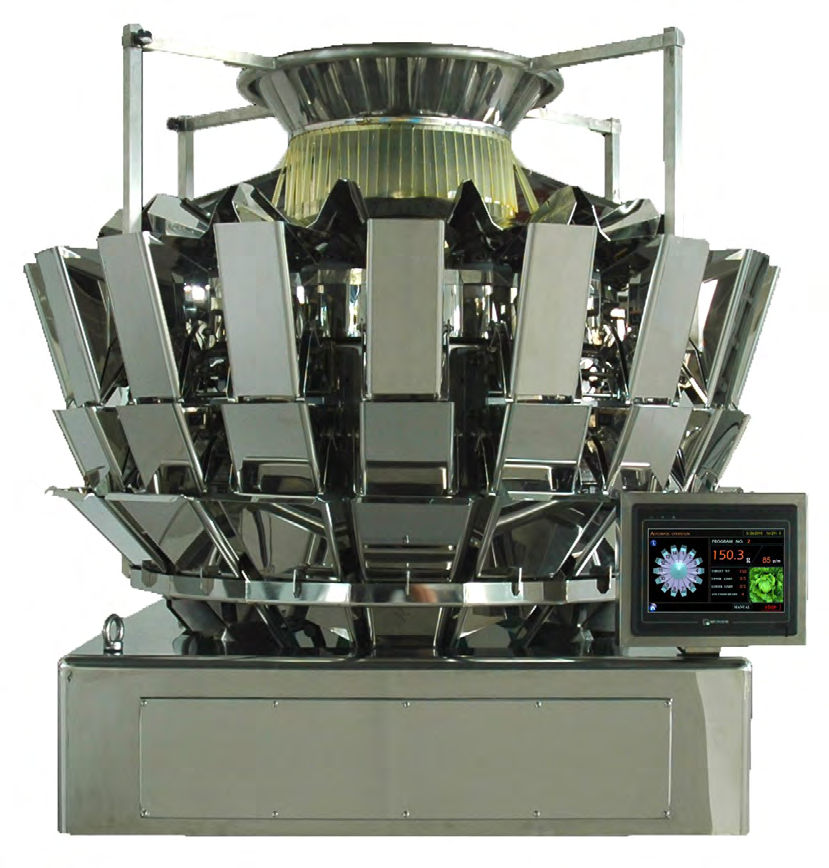
Dosing of powders, granules or liquids.
Mixing and grinding
Dissolvers, basket and continuous mills, homogenisers.
Temperature control
Heating and control for food and industrial processes.
Lab and pilot
Small extruders, dissolvers, applicators and more.
Plant engineering
Engineering a whole plant, not only an individual machine.
Smart mixing devices
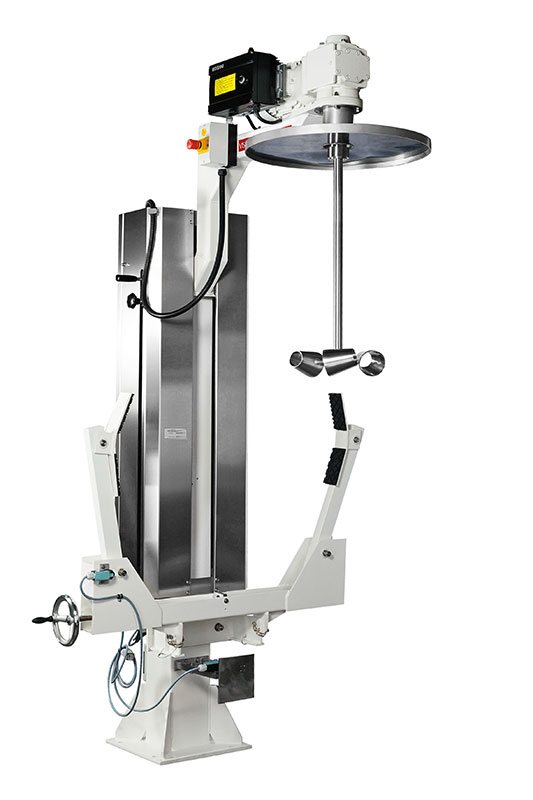
Slow-speed mixing that draws in no air and adds no heat.
Visco Jet's conical mixing elements circulate the entire batch at low speed. The liquid is homogenised without air being entrained, without the batch heating up, and on a fraction of the energy a high-shear disperser needs.
Three geometries cover the viscosity range: Spiral Cones for high viscosities, Closed Cones for low viscosities, and the patented Crack, which shears and breaks down agglomerates. Homogenisation, suspension and dispersion on the same shaft.
Gravimetric dosing
Loss-in-weight dosing of powders, granules and liquids.
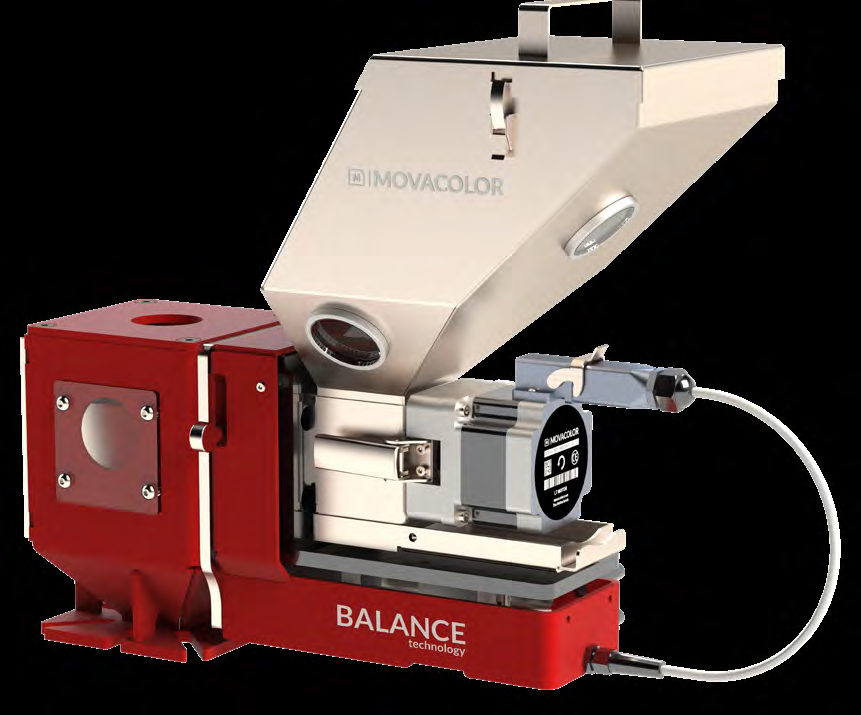
Movacolor's Balance units weigh continuously and correct themselves as they run, so the addition rate holds even as bulk density drifts. They mount on the machine throat, on a mobile stand beside the machine, or in a materials room away from the floor.
For liquid colour the MCLiquid works through a peristaltic pump with replaceable hoses, which turns a colour change into a hose change, and its gravimetric control compensates for changes in viscosity on its own. Poorly flowing powders are Scholz's speciality, with feeders covering 0.3 to 30,000 litres an hour.
Container batch mixers
The container is the mixing vessel, so a product change is a container change.
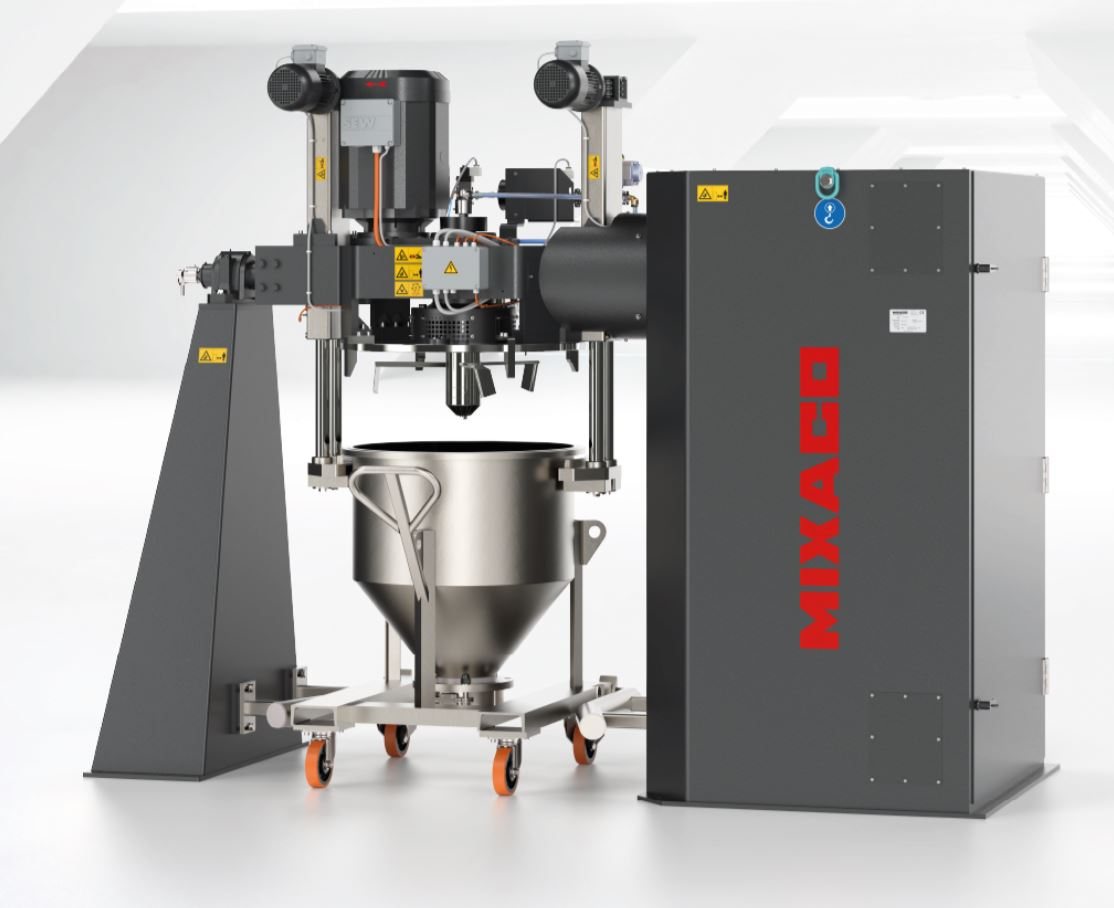
The batch is loaded, mixed and moved on in its own container, which takes the wash-down out of a product change. Three types cover most of the work: the Multitool, for temperature-sensitive materials, with a chopper for a range of mixing duties; the i4 flex, a flat-head mixer that suits a range of containers, cleans easily between changes and is direct-driven at high speed; and the Vortex, which builds heat by friction and drives the material into a vortex flow.
Charging stations, discharge stations to a gallery or to the floor, and a walk-behind container mover complete the line. Alongside them Mixaco builds a high-intensity mixer for 20 to 2,500 litres, a universal vertical mixer with a fixed vessel for 5 to 6,000 litres, and laboratory versions of both.
Heating and cooling mixer
Heat in by friction, heat out under control, in one combination.
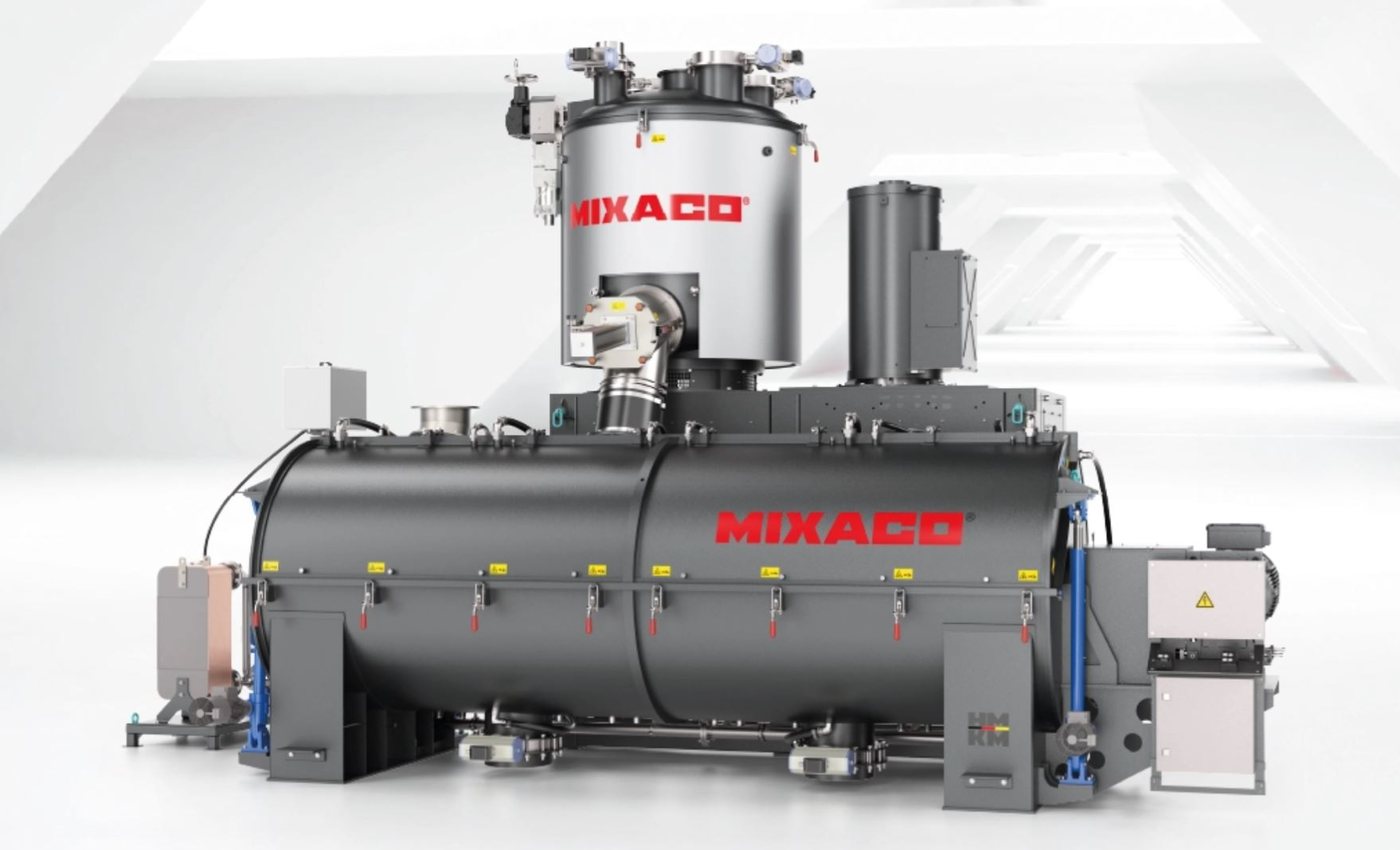
The vertical heating mixer runs its tool at 10 to 40 metres a second and takes the batch up to temperature on friction alone, distributing the recipe evenly as it goes. At temperature the material passes to the cooler below, where water fed into the mixer bottom and side wall brings it back down.
The cooler comes either vertical, to around 2,500 kg an hour, or horizontal with cooling zones around the circumference, for over 8,000 kg an hour. It is a standard route to dry blends of hard and soft PVC, and it also serves masterbatch, additives, powder coatings and powder mixtures.
Vacuum mixing and liquid processing
Automatic production of liquid to paste-like products.
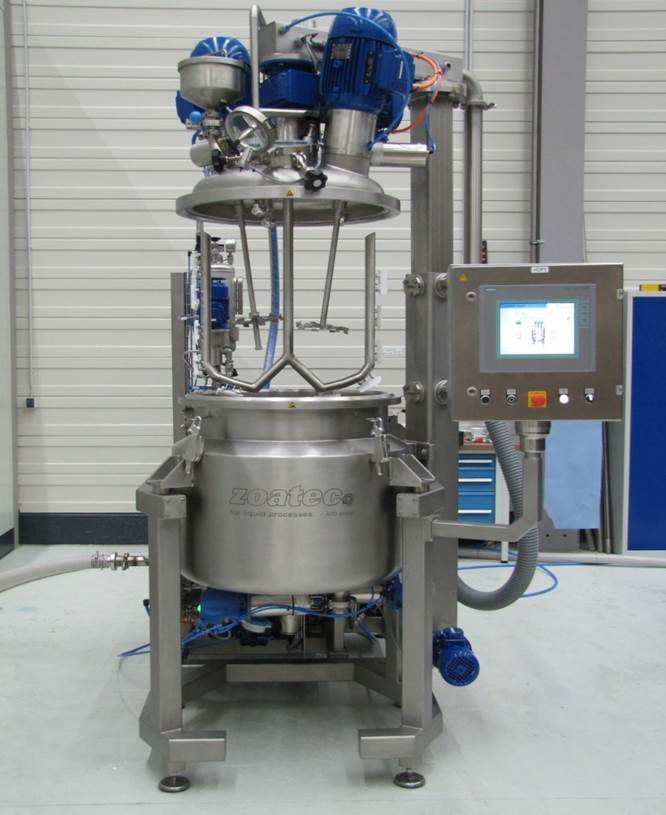
AZO LIQUIDS — founded in 2008 as zoatec, now part of the AZO group — builds batch and continuous plants around its own homogeniser, which also works as a machine on its own. The batch vacuum processing plants, type zoatec BG, mix, disperse and emulsify dry powders into liquids, and are built for short batch times.
The plants are assembled from standard modules on shared geometry, so a process proved at laboratory scale scales up predictably. For continuous work the zoatec CPU handles varying amounts of dry substance at variable shear, metering solids against flow meters. Pharmaceuticals, food, cosmetics and speciality chemicals.
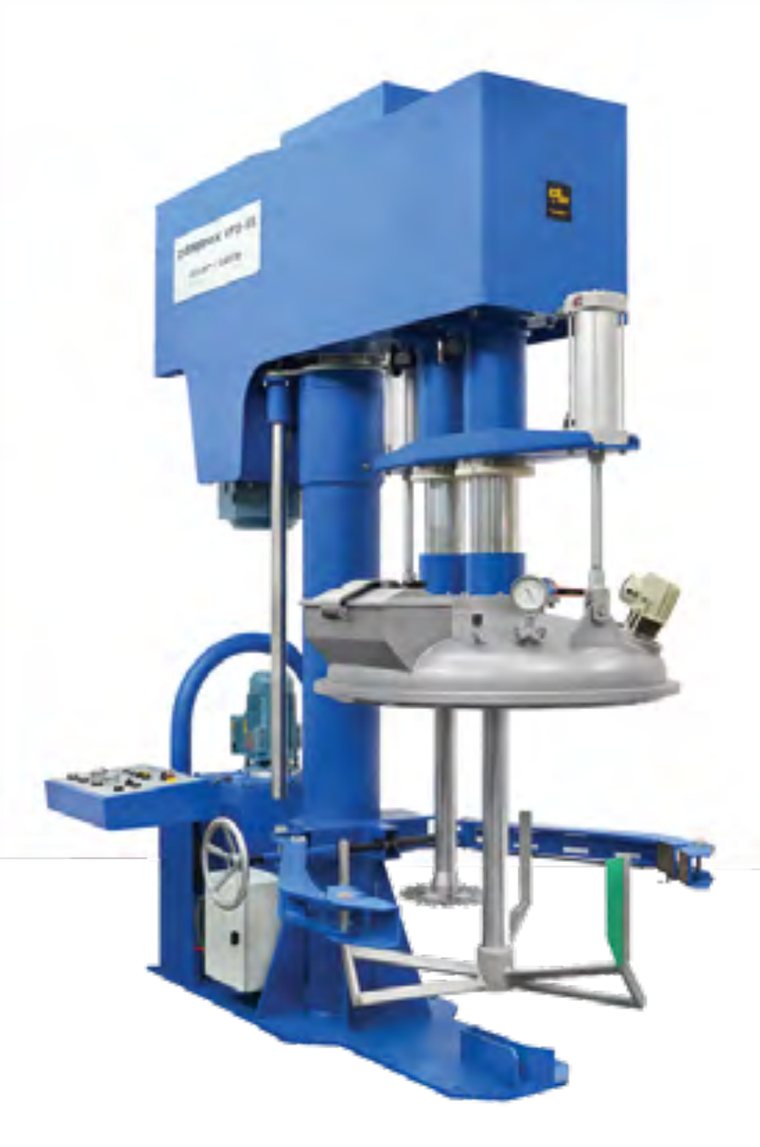
Liquid production lines
The whole paint plant, from the first mixing tank to the pallet.
Oliver Batlle build the line rather than the individual machine: high-shear mixing and homogenisation at any viscosity and any level of automation, ATEX rated where the solvent demands it.
Grinding is wet, in basket mills or in continuous or batch horizontal mills, again with an ATEX option. Filling covers every container type, by weight or by volume, at any rate and any viscosity, and carries on into end-of-line palletising.
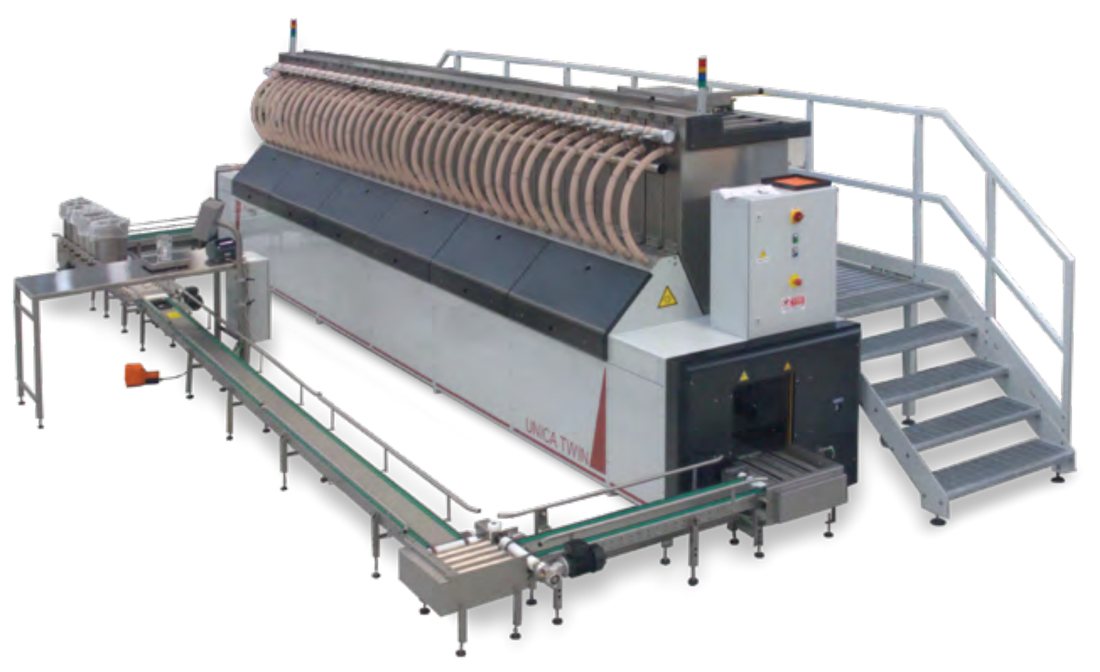
Automatic weighing — Supercolor
Powder recipes weighed to 0.01 g, without an operator at the scale.
Independent silos stand in line on a modular frame: up to ten standard 150-litre silos, or five double silos of 300 litres, per module. A trolley carrying the scale travels to each silo in turn and dispenses through Lawer's patented combined screw-and-vibration device, which is what lets a powder dye be placed quickly and still land on weight.
The silos are filled by vacuum, buckets load and unload on their own, and an extraction and filter unit keeps the dust out of the room. The system takes its recipes from the ERP and reads barcodes. Throughput runs from eight weighings an hour, at batch weights from a few grams to tens of kilograms.
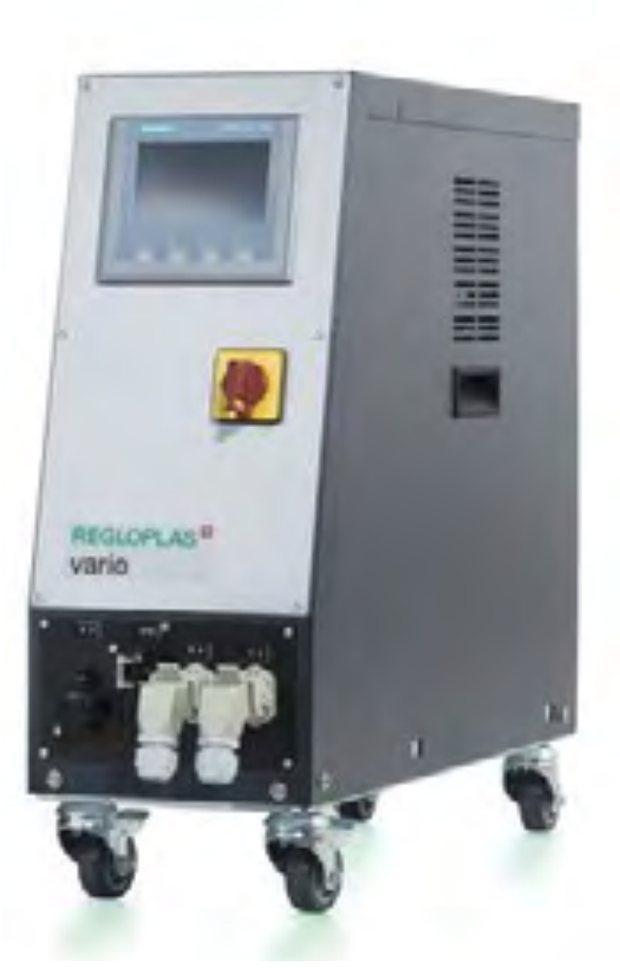
Temperature control
Water to 230 °C, thermal oil to 350 °C, on the same controller family.
The water units run from 90 to 230 °C with 9 to 60 kW of heating, up to 160 kW of cooling and flows to 200 litres a minute. The thermal-oil units reach 350 °C with 9 to 40 kW of heating, the same 160 kW of cooling and flows to 90 litres a minute.
Dynamic control is available for both water and oil, with or without an energy accumulator, and chiller units combined with free cooling supply the cold water side — which is where most of the energy saving in a temperature-control system actually comes from.
Raw-material intake and conveying
The first link in the plant: get the raw material in clean, with no dust in the room and no foreign bodies in the process. The drawings are AZO's own — they engineer the whole plant, not only the individual machine.
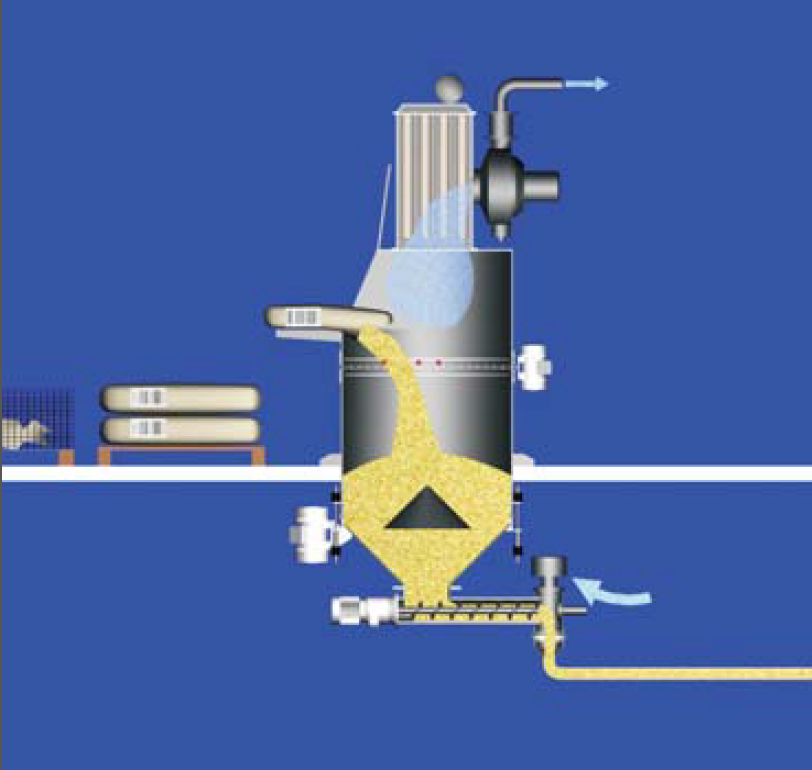
Bag discharge station
The extraction starts before the dust does.
Opening the lid of the tipping hopper starts the vacuum, so the sack is cut and emptied into a hopper that is already drawing air; the dust ends up in a filter rather than in the room. From there the material feeds straight into the closed handling or pneumatic conveying system.
The same station can be built to take big bags as well as sacks. Where the raw material has a pharmacological effect at low dose, or is moderately toxic, the OEB 3 version puts the bags through a lock chamber on a roller train, with a two-hand control on the slide gate valve.
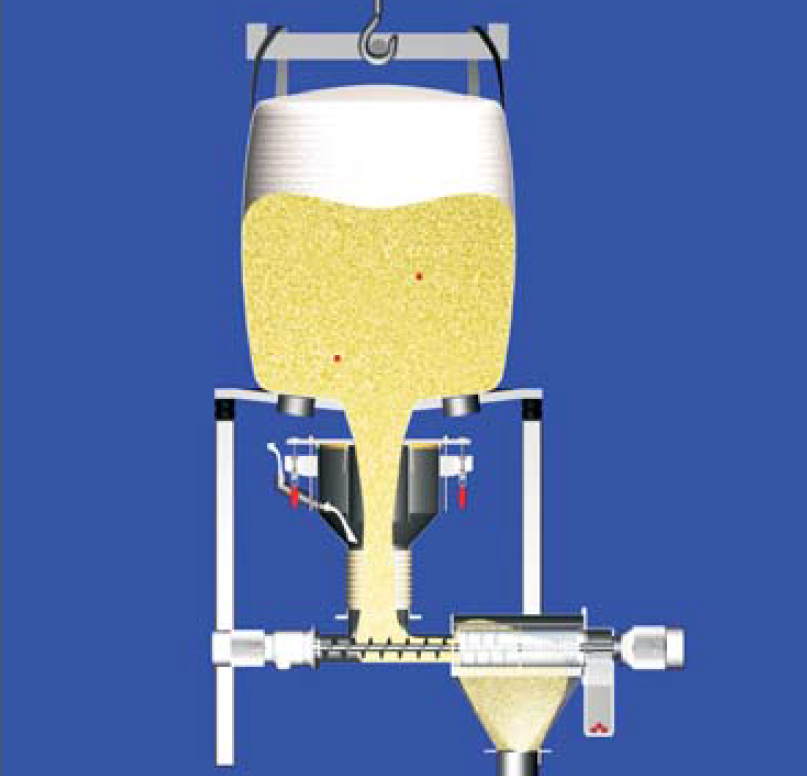
Big-bag discharge station
Built from a construction set, so the station matches the material.
Frame, traverse, chain hoist, discharging aids, docking system, buffer bin and discharge unit are each chosen for the job rather than taken as one fixed machine. Powders that will not flow get a massage device on the support table, or a vibrator, to keep the bag emptying to the end.
Docking is dust-free and asks nothing special of the bag: a standard outlet, or even a bag with a short spout or none at all, connects at the interface to the bulk material system.
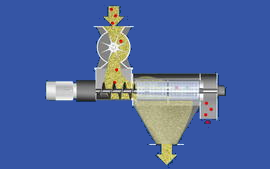
Screening
One device holds back foreign bodies, breaks up lumps, and in one type doses as it screens.
The cyclone screener sits in the conveying line and checks the material before, during and after processing, which is what keeps a HACCP regime honest. Type E is the control and safety screener, type FA works in the pneumatic conveying stream and fractionates as it screens, and type DA screens and doses in the same device.
The screen basket is held on snap locks: it pulls out and swings to the side for inspection or exchange, so a check between two products is a few minutes rather than a strip-down.
Pneumatic conveying modes
Pressure and vacuum conveying, each in three densities. Dense phase moves the material in slugs at low velocity, which is what keeps the granule intact, the blend from separating, and the energy bill down.
- Pressure conveyingSemi dense phase · Dense phase · Dilute dense phase
- Vacuum conveyingSemi dense phase · Dense phase · Dilute phase
For plastics production
The other half of the offering: the equipment that stands around the moulding machine or the extruder — drying, dosing, blending, granulating, and the temperature control that holds all of it together.
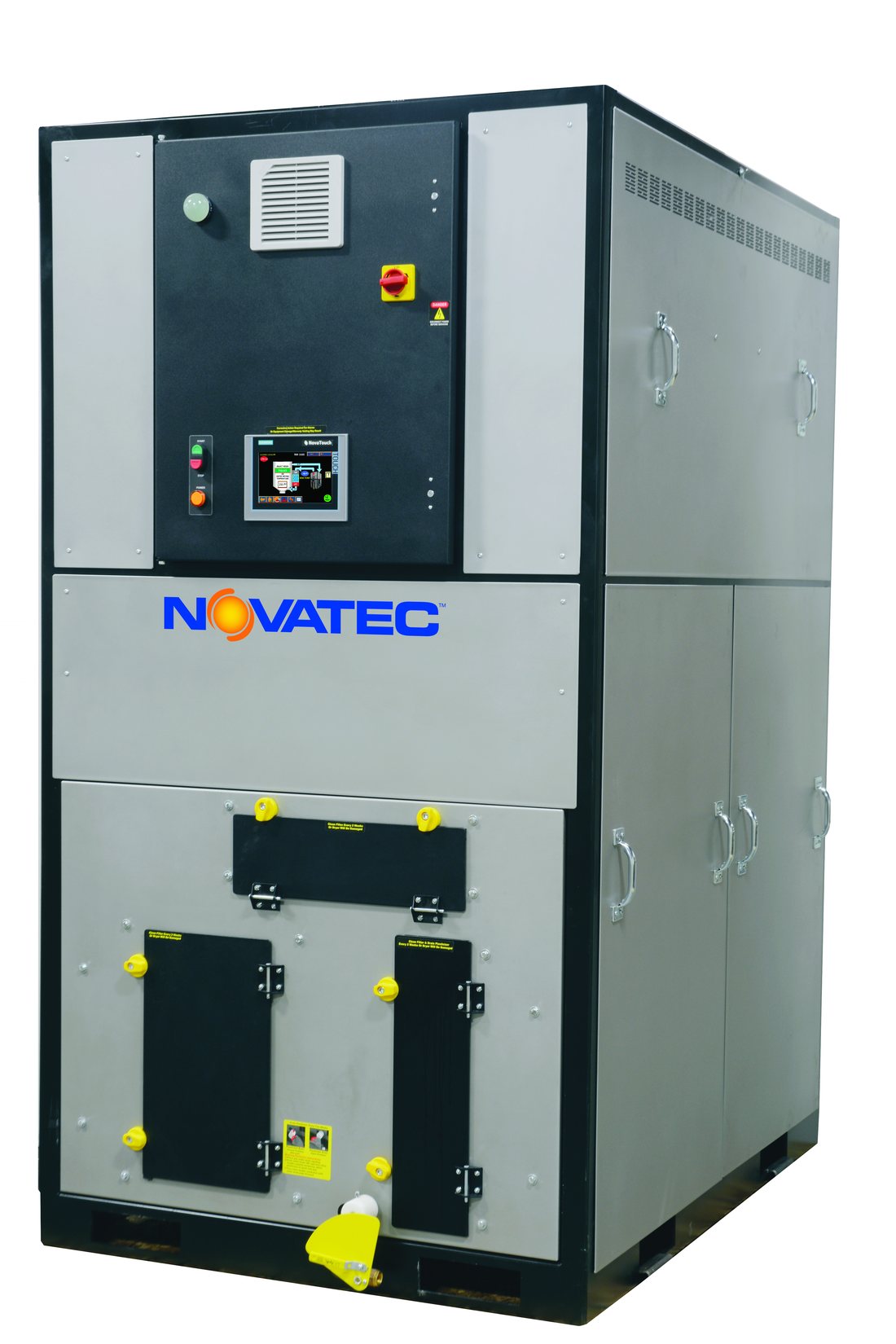
Drying
Every drying method for thermoplastics, chosen by what the polymer actually needs.
Novatec is the largest American maker of resin dryers and supplies complete materials-handling systems rather than single units: desiccant honeycomb dryers, a membrane dryer and infra-red drying, each suited to a different combination of polymer, throughput and dew point.
Labotek covers the same ground from Denmark — honeycomb, compressed-air and membrane dryers, with conveying and storage around them, and with a development effort pointed squarely at cutting the plant's power bill. The Con-Evator SVR, Mini-Feed, Desiccant Mobile Rotor, Rotor Hopper Dryer and Gravi-Dryer make up the range.
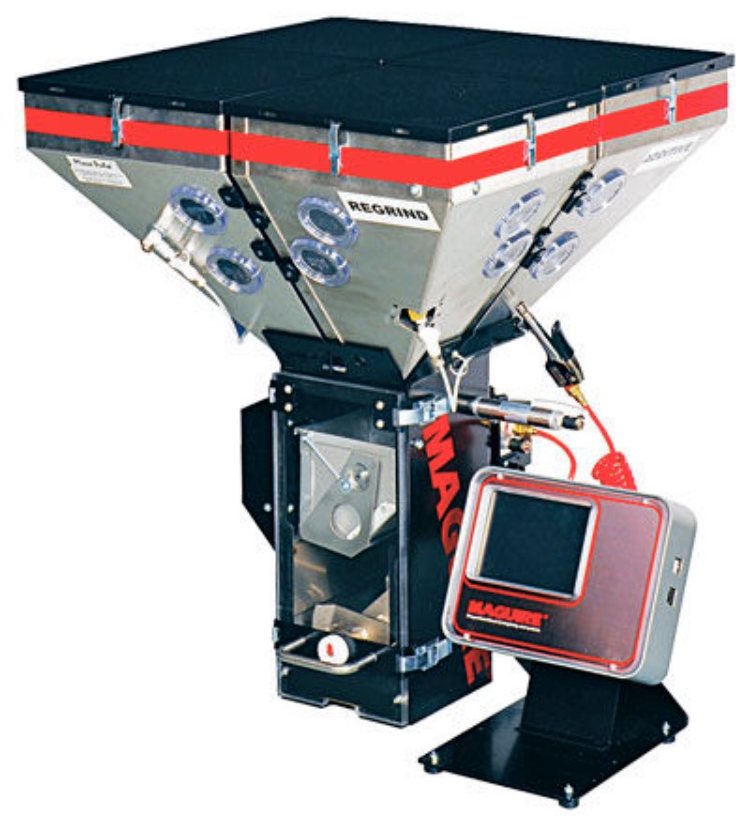
Gravimetric blending
Two to twelve components, 20 kg an hour to 5 tonnes an hour.
Maguire pioneered the weigh scale blender and has close to 60,000 of them running since 1989, in something like 120 model configurations. Each batch is weighed rather than metered by volume, so the recipe holds regardless of how the pellets flow that day.
The same range includes a vacuum dryer that cuts drying time to roughly a quarter to a sixth of conventional drying, which matters most on the hygroscopic engineering polymers where drying, not moulding, sets the cycle.
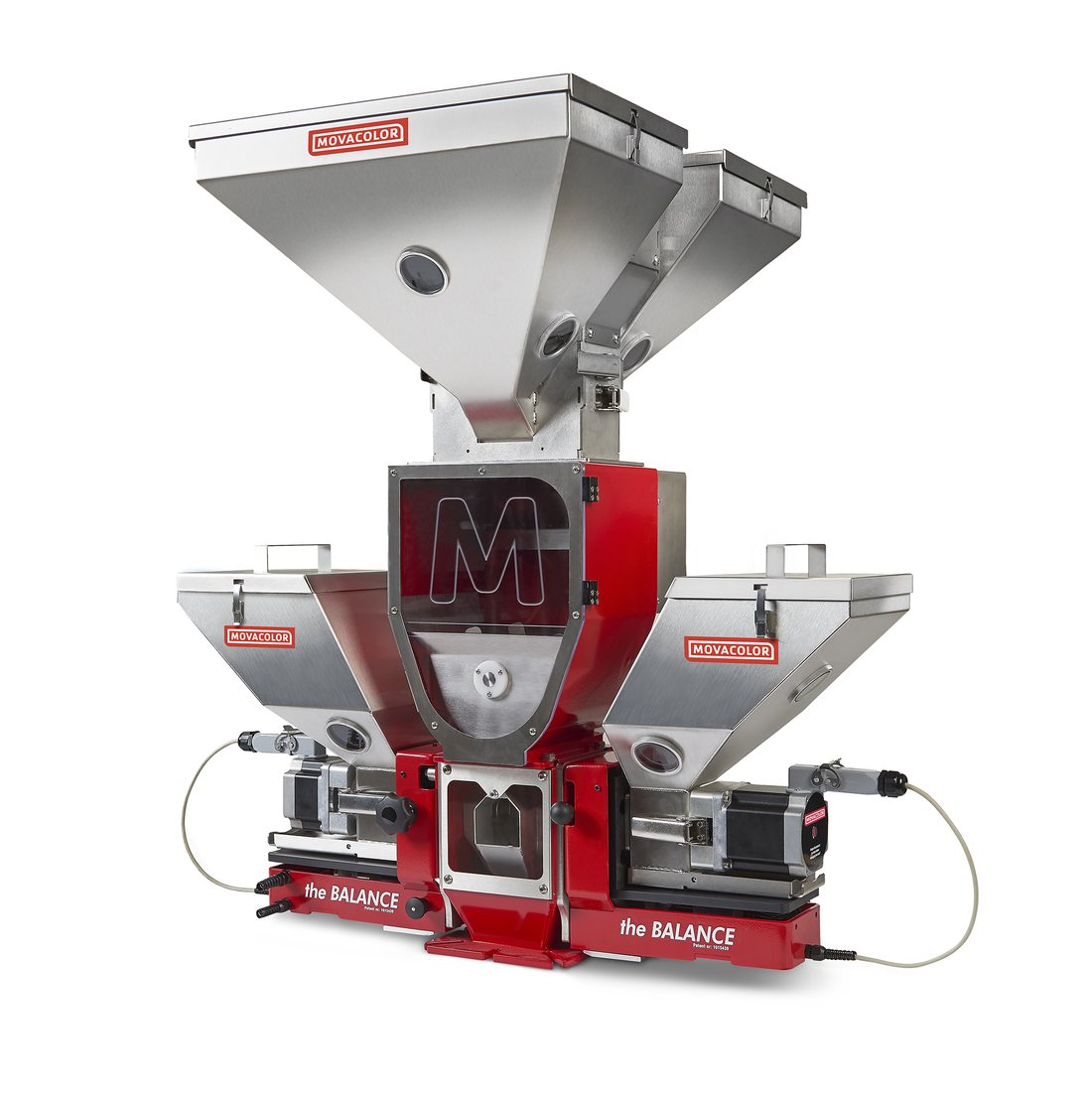
Hybrid dosing and blending
Batch blending for the main materials, continuous dosing for the additives.
Movacolor's hybrid unit was the first of its kind: gravimetric batch dosing with a blender for the base polymer and regrind, and alongside it accurate continuous gravimetric dosing for colour and additives, up to 350 kg and several materials at once.
It exists because the two jobs have different tolerances. The base materials need throughput; the additive at 0.5% needs precision. Splitting them lets each run the way it should instead of compromising on one blender.
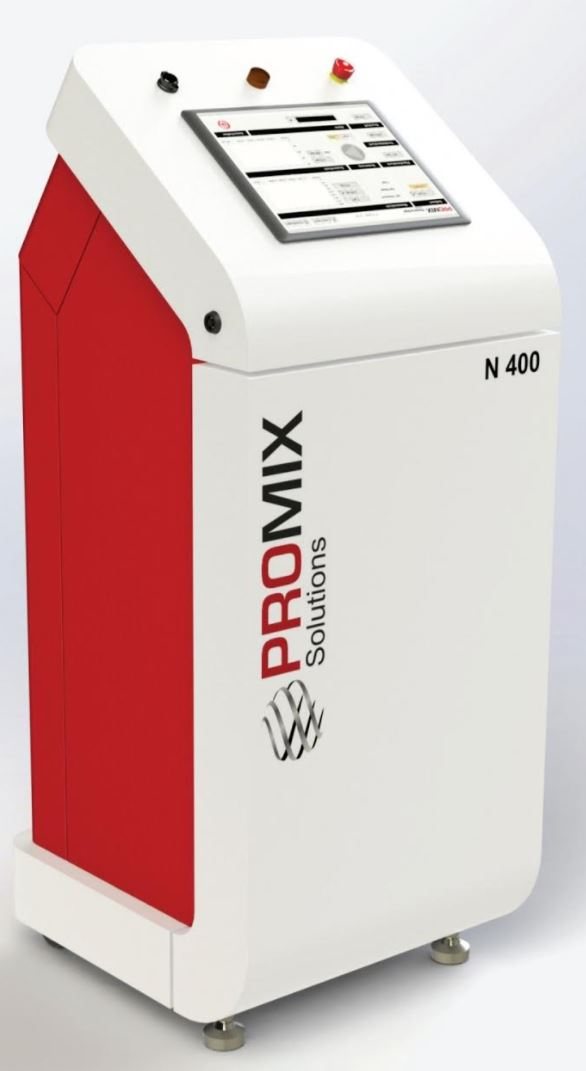
Static mixers and physical foaming
Better melt uniformity, and foaming without a chemical blowing agent.
Promix Solutions — formerly Sulzer, with more than 40,000 installations — makes static mixers for injection and extrusion. Putting one in front of the tool evens out the melt thermally and in colour, which widens the process window and, in practice, lets the colour and additive dosing come down.
The foaming systems inject CO₂ or nitrogen directly into the extruder barrel, so sheet, pipe and profile can be foamed without a chemical blowing agent. Bubble size stays under control and the material saving is substantial. Melt coolers and inline viscosity measurement round out the range.
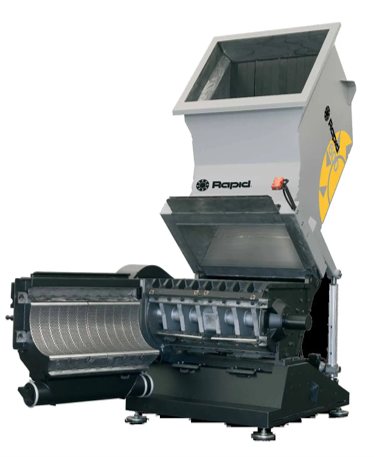
Granulators
Grinding the sprue back into the process, next to the press or centrally.
Rapid has built granulators in Bredaryd, Sweden since 1942. Hundreds are running in Israel, some of them for over fifty years. The range runs from beside-the-press machines through central granulators to the Raptor shredders, with dust separation, metal detection and monitoring built around them.
Where the material is tough or the noise matters, Mo-Di-Tec's low-speed granulators are the alternative — the company invented the type in 1981 and specialises in ABS, PA, PC, PBT and POM, grinding quietly, with little dust and less wear in a small footprint.
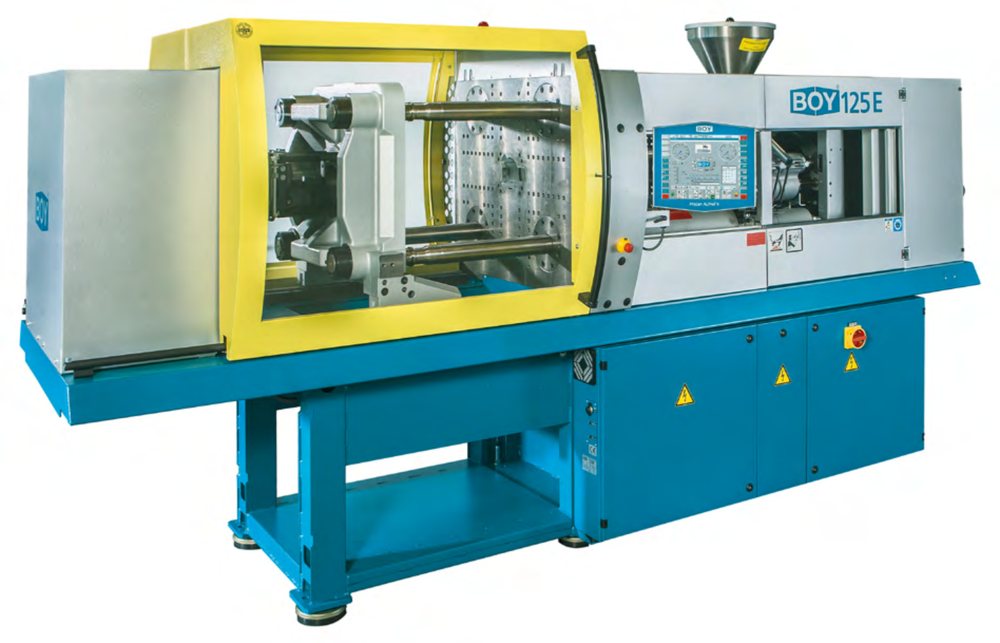
Injection moulding machines
Compact enough for a pilot cell, solid enough for production.
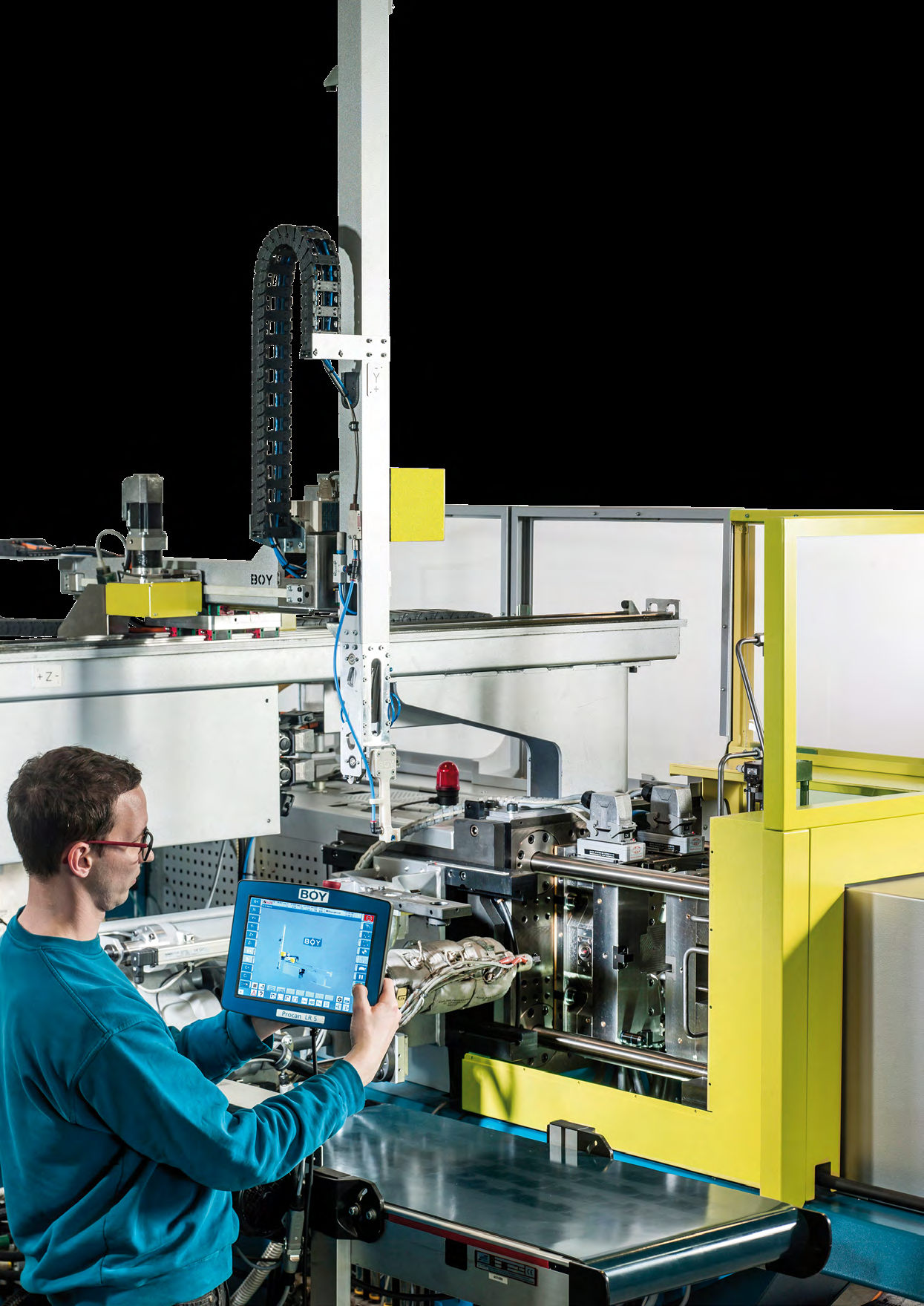
Dr. Boy builds two-platen, servo-hydraulic injection moulding machines from 100 to 1,250 kN of clamping force — 10 to 125 tonnes — and has delivered over 50,000 of them worldwide.
Florma's range concentrates on the 63 to 125 tonne end. That is the size where a machine can carry a development programme and then go on making the part, which is why it turns up in medical and laboratory work as often as in general moulding.
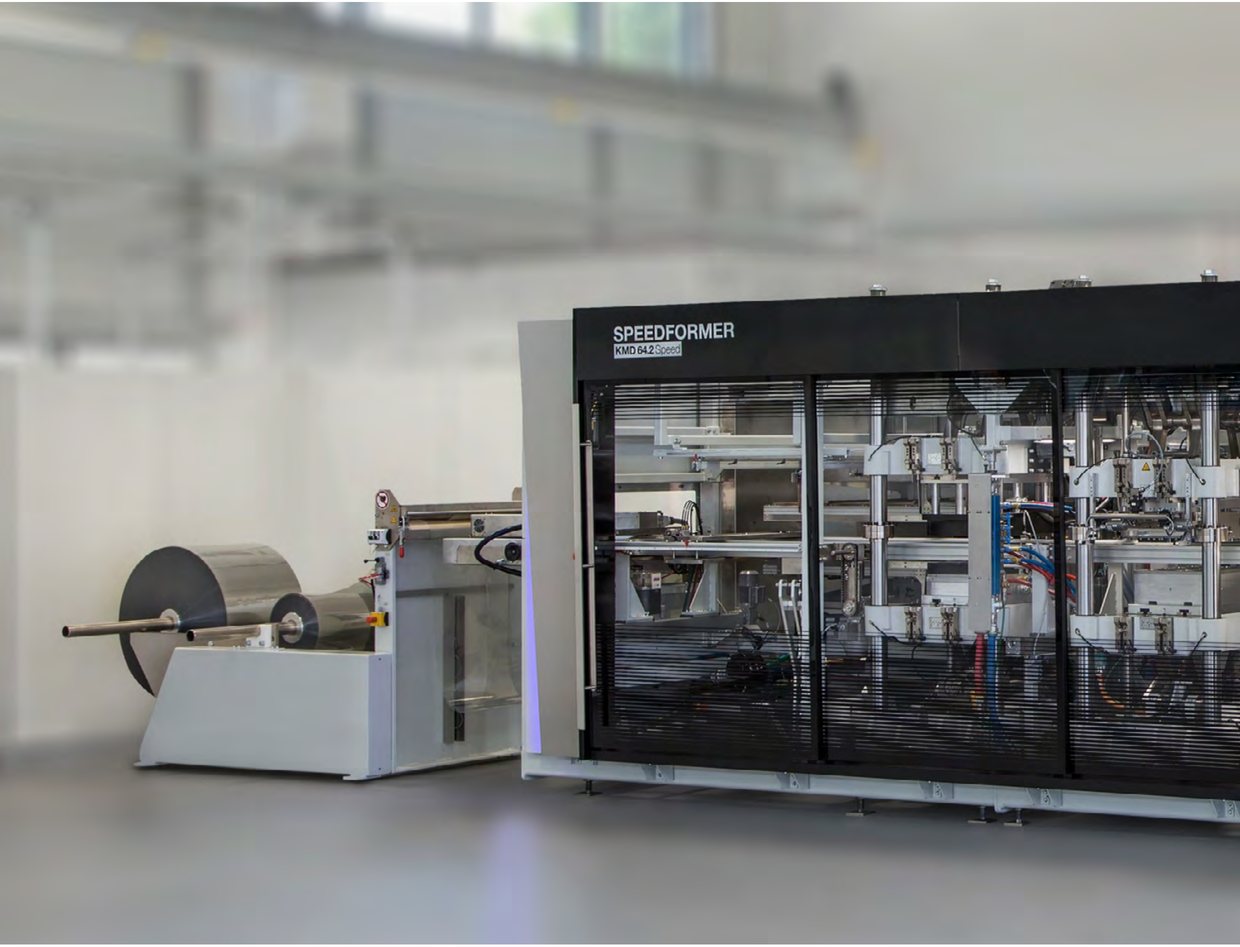
Thermoforming lines
Forming, automation and welding for packaging and medical products.
Kiefel has built thermoforming lines for more than sixty years and employs around 3,000 people. The business covers thermoforming itself, packaging automation, and packaging formed from natural fibre rather than plastic.
The same engineering runs through its medical work, where the machines weld and fill medical bags — a job that is really thermoforming held to a different standard of validation.
Our catalogues
The latest editions, free to download.